
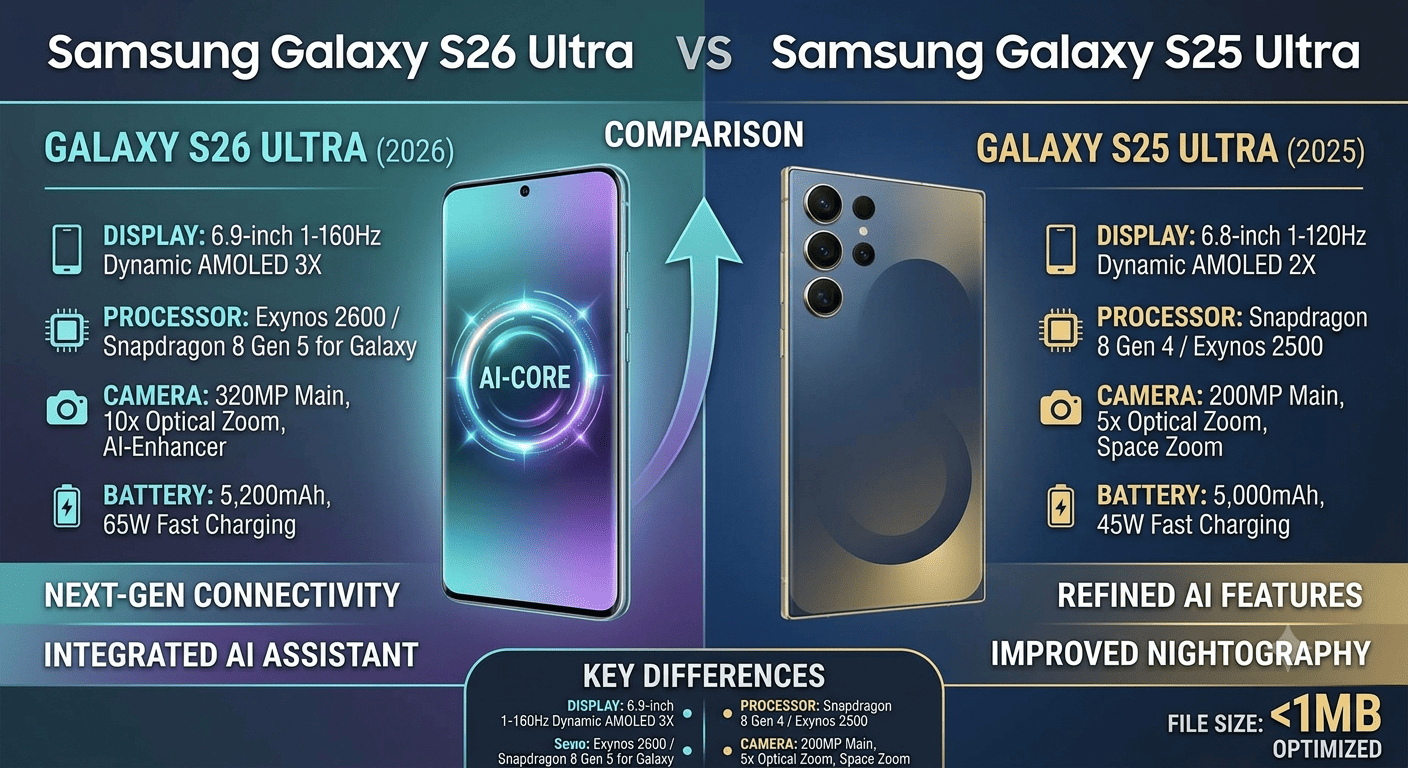
For the last few product cycles, smartphone flagships have felt dangerously iterative. Minor camera software tweaks here, a slight bump in peak screen nits there, and a design profile that looks identical to the phone you bought two years ago.
But with the recent launch of the Samsung Galaxy S26 Ultra, Samsung is attempting to break out of that iteration trap.
Equipped with a highly anticipated 2nm chip, faster charging protocols, and a completely unique hardware-based privacy feature, the S26 Ultra signals a fundamental pivot in how a powerhouse phone should protect your data and handle AI orchestration.
If you are holding the Galaxy S25 Ultra, or deciding whether to grab a discounted previous-gen model, the choice isn’t as simple as checking standard benchmark numbers. Let’s dive straight into the deep architectural differences between the S25 Ultra and the S26 Ultra.
1. Structural Design: The Move Back to Armor Aluminum
When Samsung introduced Titanium to the Galaxy S25 Ultra, it was hailed as a massive durability leap. However, the S26 Ultra makes an unexpected U-turn back to what Samsung brands as Armor Aluminum.
[S25 Ultra] —> Titanium Frame (218g) —> Sharp, Boxy Corners [S26 Ultra] —> Armor Aluminum (214g) —> Sleek, Rounded Edges (-0.3mm thinner) ```
Why the regression? It’s entirely thermal and ergonomic. High-grade aluminum has noticeably better heat dissipation properties than titanium, which is vital for housing the intense thermal demands of next-gen mobile processing blocks.
Furthermore, the S26 Ultra drops the sharp, boxy corners of the S25 Ultra in favor of slightly rounded, ergonomic edges that align cleanly with the rest of the S26 lineup. It weighs slightly less at 214 grams and is a noticeable $0.3\text{ mm}$ thinner, making it vastly more comfortable to hold for extended deep-work sessions.
2. World’s First “Privacy Display” Architecture
layout: post title: “Three Hundred Towns Just Told AI to Build Somewhere Else” description: “AI data centers are triggering a fast-growing wave of local opposition across the US, from moratoriums to canceled billion-dollar projects, as communities push back on water and power use.” date: 2026-06-29 12:00:00 +0000 categories: [ai, technology] tags: [data-centers, ai-infrastructure, energy, community-backlash] image: /assets/trap.png —
On July 14, 2026, New York Governor Kathy Hochul signed an executive order creating the nation’s first statewide moratorium on new hyperscale data centers. It wasn’t an isolated move. By that point, according to a count by The Information, more than 300 cities, towns, and counties across the country — from Monterey Park, California to DeKalb County, Georgia — had already placed bans or moratoriums of their own. The AI industry’s infrastructure buildout has run headlong into a resistance movement that barely existed two years ago, and it’s now large enough to actually stop projects, not just slow them down.
The Numbers Behind the Pushback
The scale of disruption is no longer marginal. Data Center Watch tracked at least 75 major projects worth more than $130 billion delayed or canceled in just the first three months of 2026 alone, due in part to organized local opposition. A separate review of public records found at least 25 projects canceled outright in 2025 in direct response to community objections, and earlier tracking from Data Center Watch found $98 billion in projects blocked or delayed between March and June 2025 — meaning the pace of opposition-driven disruption has been accelerating, not leveling off.
Public sentiment backs up why this is happening at scale: a recent Gallup poll found seven out of ten Americans oppose data centers being built near them, with water use cited as a top concern. That’s not a fringe NIMBY position anymore — it’s a clear national majority.
Why Water Is the Flashpoint
The physical resource demands driving this backlash are genuinely large. A mid-sized data center consumes roughly as much water as a small town, and larger facilities can require up to 5 million gallons a day. In water-stressed regions — the American West in particular — that cooling demand competes directly with agricultural and residential water use, and residents in those areas describe dried-up wells and rising municipal water costs tied directly to nearby facilities.
Ireland offers a preview of what happens when this scales further than communities can absorb: data centers there recently consumed more than 20% of the country’s metered electricity, prompting the national grid to effectively pause new data center approvals around Dublin entirely, to protect the broader power system. It’s worth noting the tradeoff isn’t as simple as “just use less water” — data centers can be cooled with minimal water use, but doing so requires substantially more energy instead, meaning operators are often choosing which scarce resource to strain rather than avoiding strain altogether.
The Energy Side Is Just as Stark
A January 2026 report from on-site energy company Bloom Energy projects that total U.S. data center energy demand will nearly double between 2025 and 2028, climbing from 80 to 150 gigawatts — equivalent to adding a country with Spain’s entire energy needs within three years. That demand is already showing up on household bills: in some regions, electricity prices have risen 20–30% in ways directly attributable to data center demand, according to reporting on the backlash, and residents describe watching public funds get offered as incentives to attract these projects while their own utility costs climb in parallel.
This Has Become a Genuine Political Issue, Not Just a Local One
Lawmakers have taken notice at scale: more than 30 states have introduced upwards of 300 bills in 2026 addressing data centers — moratoriums, tax incentives, mandatory water-usage reporting, and broader energy policy. New York state senator Liz Krueger, co-author of that state’s moratorium bill, framed the stakes in blunt terms: without a pause to develop stronger policy, the state risks getting caught inside a bubble that eventually bursts and leaves ordinary utility customers holding the bill.
What’s notable is how the opposition is cutting across the usual political lines. Reporting from Virginia — the world’s largest data center hub, hosting roughly 13% of the globe’s data centers as of 2023 — describes local activists explicitly rejecting a partisan framing of the fight. One longtime Virginia organizer, who has spent a decade opposing data center expansion near her home, put it directly: this was never a red-versus-blue issue, it’s people who live somewhere versus people who want to industrialize where they live. That framing appears to be holding up heading into the 2026 midterms, with candidates in both parties increasingly treating data center opposition as something close to a prerequisite for running competitively in affected districts.
The Industry’s Response So Far
Tech companies aren’t standing still on this. A number of executives have signed onto a White House-sponsored pledge specifically aimed at limiting the effect of AI infrastructure buildout on residential electric bills — a direct acknowledgment that the utility-cost angle of this backlash has become politically serious enough to require a public response, not just private lobbying. Whether that pledge translates into measurable relief for the households already seeing higher bills remains to be seen, and it hasn’t slowed the pace of new moratorium bills moving through state legislatures.
Brookings has framed the stakes for the industry starkly: the think tank’s own analysis warns that unresolved local resistance could genuinely stall the buildout of AI infrastructure nationally if it isn’t addressed directly, rather than simply pushed through over community objections project by project.
What This Actually Means for AI’s Trajectory
It’s worth being precise about what this backlash is and isn’t. It isn’t opposition to AI as a technology in the way some earlier tech backlashes have been broadly anti-innovation — most of the organizing described in this coverage centers on concrete, local, physical impacts: noise, water tables, air quality from diesel backup generators, and electricity bills, not abstract objections to what AI is or does. That distinction matters, because it means the backlash isn’t obviously solvable by better PR about AI’s benefits. It’s a resource-allocation and infrastructure-siting problem, and those tend to get resolved through zoning boards, utility commissions, and state legislatures — exactly where this fight has now firmly relocated.
The AI industry’s spending trajectory assumes continued, large-scale data center expansion for years to come. What’s becoming clear through 2026 is that the physical world hosting that expansion has its own limits and its own political process, and neither is moving at the pace the industry’s capital expenditure plans assume. Three hundred local moratorium decisions, made independently across the country by people mostly reacting to their own water bills and utility rates rather than any coordinated national campaign, may end up shaping where and how fast AI infrastructure actually gets built as much as any single company’s capex guidance does.
While both generations offer a massive, crisp 6.9-inch display, the S26 Ultra introduces a massive security upgrade: Hardware-level Privacy Display.
Integrated within the Gorilla Glass Armor 2 display panel, this feature acts like a dynamic, built-in privacy screen protector. When turned on—either manually or automatically via One UI 8.5 when opening sensitive software like corporate banking or health apps—it sharply constricts the screen’s viewing angles. To anyone looking at your device from the side, the display appears dark, entirely neutralizing “shoulder surfing” in public transit or coffee shops. The S25 Ultra offers no such native structural barrier.
3. Raw Under-the-Hood Power: Snapdragon 8 Elite Gen 5
The engine room is where the S26 Ultra builds its massive performance moat.
- The Galaxy S25 Ultra utilizes the Snapdragon 8 Elite chip.
- The Galaxy S26 Ultra ships globally with the Snapdragon 8 Elite Gen 5 system. The Gen 5 silicon delivers a profound multi-core architecture jump, dropping temperature strain by roughly 8% under identical gaming or processing loads. Crucially, to handle the heavy memory footprint of local, on-device AI orchestration models without lagging, the S26 Ultra elevates its baseline memory profile up to 16GB of LPDDR5X RAM on higher storage tiers, compared to the S25 Ultra’s fixed 12GB ceiling.
4. The Camera F-Stop Evolution
On paper, the camera arrays look twins: both carry a monster 200MP wide lens, a 50MP ultrawide, a 10MP 3x telephoto, and a 50MP 5x periscope telephoto.
However, the S26 Ultra brings crucial hardware lens updates:
- Wider F/1.4 Aperture: The main 200MP sensor drops from the S25 Ultra’s $f/1.7$ down to a significantly wider $f/1.4$ aperture. This allows the sensor to pull in substantially more physical light, resulting in dramatically cleaner low-light video capture and reduced computational noise.
- Dedicated Front-Facing ISP: For creators and professionals on the move, the 12MP selfie camera on the S26 Ultra now features a dedicated, isolated Image Signal Processor (ISP) to handle portrait video streaming and low-light facial tracking cleanly before software processing even begins.
5. Charging Speeds Finally Break the 45W Barrier
Samsung has long lagged behind competitors when it came to charging protocols, bottlenecking their devices at 45W for generations. The S26 Ultra finally breaks that wall, bringing 60W Super Fast Charging 3.0 to the table.
While both phones maintain a 5,000 mAh battery capacity, the S26 Ultra can juice up from 0% to 75% in roughly 30 minutes. Additionally, it integrates Qi2 wireless charging with native magnetic alignment at 25W, allowing you to use snap-on magnetic accessories seamlessly, an operation that requires a dedicated third-party case on the S25 Ultra.
Direct Spec Comparison: S26 Ultra vs. S25 Ultra
| Feature | Galaxy S25 Ultra | Galaxy S26 Ultra |
|---|---|---|
| Chassis Material | Titanium Frame | Armor Aluminum (Optimized Heat Dissipation) |
| Display Spec | 6.9-inch Dynamic AMOLED 2X | 6.9-inch Panel with Hardware Privacy Display |
| Processor | Snapdragon 8 Elite (3nm) | Snapdragon 8 Elite Gen 5 (Custom Galaxy Cluster) |
| Maximum RAM | 12GB LPDDR5X | Up to 16GB LPDDR5X (Optimized for local AI) |
| Main Camera | 200MP (f/1.7 aperture) | 200MP (Upgraded f/1.4 light capture aperture) |
| Wired Charging | 45W Fast Charging | 60W Super Fast Charging 3.0 |
| Wireless Protocol | 15W Standard Qi | 25W Qi2 (Native Magnetic Support) |
The Verdict: Upgrade or Hold?
If you are a heavy multi-tasker who routinely works in public spaces, handles data-heavy local tasks, or shoots massive amounts of low-light visual media, the Galaxy S26 Ultra represents an actual engineering leap rather than a lazy refresh. The combination of the 16GB RAM overhead, 60W charging efficiency, and the Privacy Display removes real-world pain points.
However, if you mainly use your smartphone for standard browsing, social management, and day-to-day productivity apps, the Galaxy S25 Ultra remains a ridiculously fast, top-tier device that will comfortably cruise through the next several years of Android updates.
Frequently Asked Questions (SEO Optimization)
Q: Does the S26 Ultra have an S Pen?
A: Yes, the Galaxy S26 Ultra fully retains the integrated S Pen stylus within the chassis, offering the same low-latency writing and system control precision as previous generations.
Q: Can you turn off the Privacy Display on the S26 Ultra?
A: Absolutely. The Privacy Display feature is entirely software-controlled within the One UI settings. You can set it to toggle manually, stay off entirely, or only activate automatically when specific, secure applications are launched.
Q: Will S25 Ultra cases fit the new S26 Ultra?
A: No. Because the S26 Ultra is 0.3 mm thinner and features updated, rounded corner geometry, older S25 Ultra cases will not align correctly with the physical dimensions of the new device.