
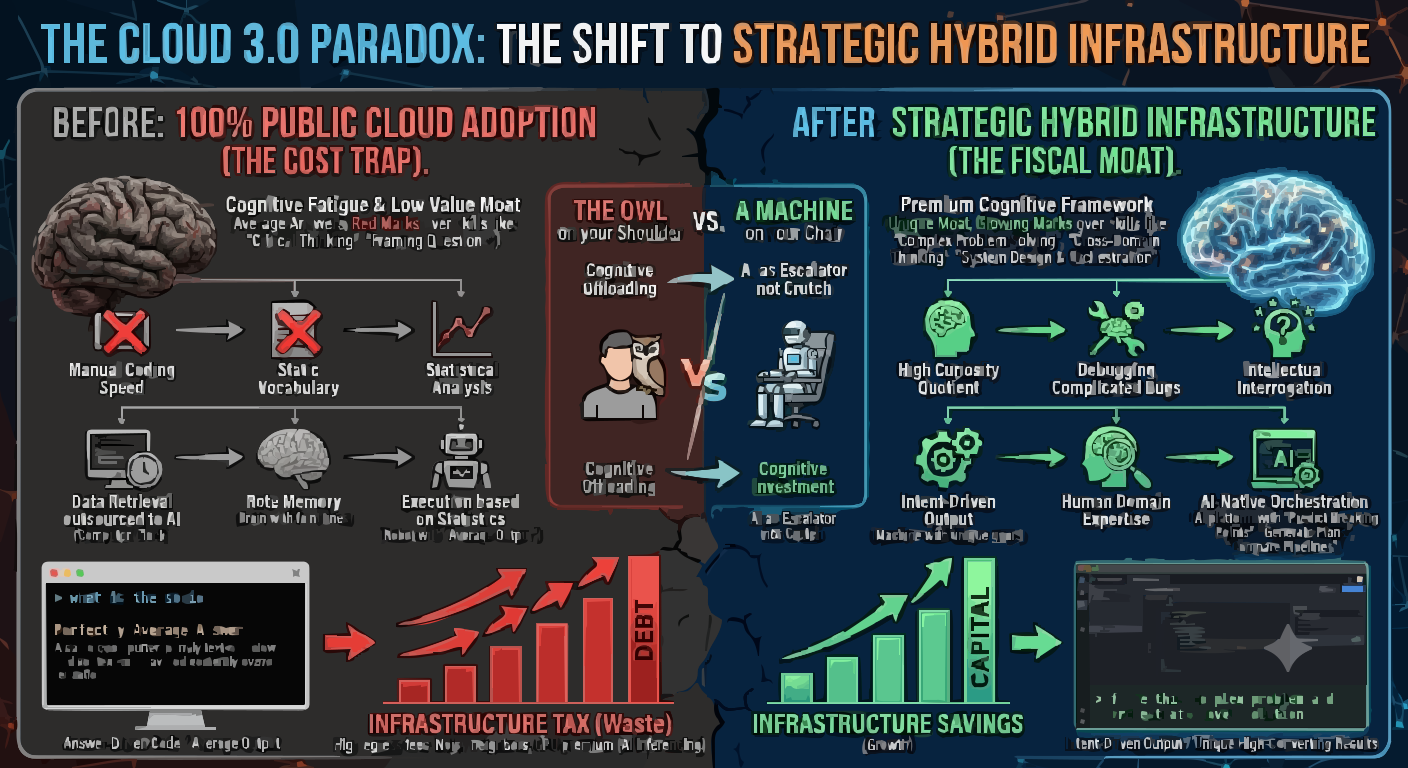
For over a decade, the architectural mandate for any scaling software house or tech startup was completely undisputed: “Cloud First.” Moving your entire development ecosystem to hyperscalers like AWS, Google Cloud (GCP), or Azure was marketed as the ultimate blueprint for frictionless agility, zero capital expenditure, and infinite scalability.
But in 2026, the economic and operational math behind that absolute reliance has flipped.
Enterprises and scaling tech services are discovering that while public clouds are unmatched for highly volatile workloads and spinning up experimental MVPs, using them to host steady-state compute, data-heavy pipelines, and continuous AI automation models is financially unsustainable.
Welcome to the Cloud 3.0 Paradox. The very platforms built to save companies money have become their heaviest margin anchors. In response, the world’s most sophisticated engineering teams are executing an aggressive pivot toward strategic hybrid infrastructure—bringing their predictable core home while keeping their burst capacity in the cloud.
1. Deconstructing the Cloud 3.0 Paradox
To understand this paradigm shift, we have to look at the evolution of cloud computing:
- Cloud 1.0 (The Commodity Era): Basic migration of raw storage and static hosting away from dusty office closets.
- Cloud 2.0 (The Monolithic Hyperscaler Era): Universal adoption of fully managed public clouds and SaaS ecosystems.
- Cloud 3.0 (The Sovereign & Hybrid Era): A hyper-mature landscape focused on data sovereignty, infrastructure autonomy, and extreme fiscal efficiency.
The paradox of the current Cloud 3.0 era is simple: The more you successfully scale inside a premium public cloud, the more you are penalized.
When your software product has ten users, a managed public cloud database costs pocket change. But when your system grows to handle millions of consistent transactions, massive data ingestion, or ongoing AI inference loops, you begin paying an immense premium for on-demand flexibility that you aren’t actually using.
[Dynamic/Burst Workloads] ----> Multi-Cloud / Public Hyperscalers (AWS, GCP)
                                      |
                           (Overlay Network Connect)
                                      |
[Predictable Steady-State] ----> Private Bare-Metal / Colocation (Hetzner, Vultr)
Industry studies reveal a staggering reality: up to 35% of global public cloud spending is pure operational waste due to idle resources and severe over-provisioning. For a modern software house trying to maintain lean engineering margins, running completely on a public cloud behaves less like an incubator and more like an unpredictable utility tax.
2. The Multi-Million Dollar Drivers Behind Cloud Repatriation
This isn’t an ideological debate; it is a major structural shift supported by massive empirical evidence. According to recent 2026 data, 83% of CIOs have planned or executed a migration of specific public cloud workloads back to private clouds, bare-metal environments, or alternative colocation infrastructure.
Three core operational forces are fueling these cloud repatriation trends:
I. The Extortionate Egress Fee Crisis
Hyperscalers famously make it free to push data into their ecosystems, but charge exorbitant network data transfer fees to pull that same data out. For data-intensive tools, digital inventory systems, and analytical software packages, these network transfer fees can silently compound into 15–20% of the entire infrastructure invoice.
II. AI Inference and the GPU Bottleneck
Running continuous AI automation models, complex vector databases, or custom LLM agents on public cloud GPU instances at sustained utilization rates is an absolute margin killer. Once an engineering team’s baseline GPU cluster utilization crosses the 60–70% mark, renting on-demand cloud hardware becomes exponentially more expensive than orchestrating dedicated or fractional alternative infrastructure.
III. The “Noisy Neighbor” Performance Tax
In a standard public cloud, your performance is frequently subject to the activity of other tenants sharing the same physical host hardware. This “noisy neighbor” effect creates subtle execution latency variances. To guarantee reliable Service Level Objectives (SLOs), tech platforms are often forced into expensive over-provisioning simply to buffer against these hardware inconsistencies.
3. The Modern Blueprint: Mixing Bare-Metal with Alternative Clouds
Modern cloud repatriation doesn’t mean moving backward to traditional on-premises management where engineers are manually racking servers in a warehouse. Instead, the modern standard relies on Infrastructure as Code (IaC) and provider-agnostic container setups to orchestrate a beautifully optimized, hybrid ecosystem.
Leading software developers are adopting a high-efficiency architectural blueprint: splitting workloads between Hetzner and Vultr alongside their legacy environments.
Infrastructure Component Workload Type Primary Benefit
Hetzner (Dedicated Bare-Metal) Predictable backends, primary SQL databases, monolithic storage nodes, and historical analytics. Eliminates hypervisor overhead, guarantees dedicated physical cores, and cuts core compute costs by 40–60%.
Vultr (Alternative Global Cloud) Managed Kubernetes (VKE) clusters, fractional/dedicated cloud GPUs, global load balancers. Delivers global cloud orchestration, seamless horizontal scaling, and ultra-low latency without hyperscaler premium fees.
Legacy Public Cloud (AWS/GCP) Ephemeral staging environments, dynamic consumer-facing frontends, and regional burst capacity. Retains maximum architectural elasticity for completely unpredictable or highly seasonal traffic peaks.
By deploying provider-agnostic tooling like OpenTofu or Terraform alongside Kubernetes, software houses can abstract away their physical hosting layer entirely. The engineering team experiences the exact same cloud-like git ops, automated pipelines, and deployment ease, while the company’s financial balance sheet reclaims massive capital.
4. Overcoming the Friction of Hybrid Cloud Management
While the raw unit economics of a strategic hybrid infrastructure are undeniably superior, building a fragmented multi-provider setup introduces real operational complexities that a FinOps team must explicitly design around:
- Unified Observability: When your components span across dedicated servers and alternative clouds, localized monitoring tools fail. Engineering teams must implement centralized, platform-wide metrics layers to monitor multi-provider system health through a single pane of glass.
- The Networking Backbone: Securing communication lines across separate providers requires a robust overlay network. Teams routinely use enterprise-grade private routing solutions (like Tailscale/WireGuard or dedicated direct-connect overlays) to securely bridge environments without passing unencrypted packets over the public internet.
- Unified Governance: Cost optimization is a continuous organizational discipline, not a one-time migration task. Organizations must maintain strict tagging policies and programmatic budget alarms across all integrated infrastructures to prevent resource sprawl.
Conclusion: Fiscal Efficiency is the Ultimate Moat
The narrative that a modern tech company must be “100% public cloud native” is officially broken. In the competitive landscape of Cloud 3.0, technological maturity is no longer measured by how many custom cloud badges your engineering department holds. It is measured by fiscal efficiency and architectural flexibility.
By shifting away from universal public cloud adoption and engineering a precision strategic hybrid infrastructure, you reclaim absolute control over your core data margins, insulate your software from unpredictable bill scaling, and turn your infrastructure architecture into an unshakeable competitive moat.
Frequently Asked Questions (SEO Featured Snippet Optimization)
Q: What is cloud repatriation?
A: Cloud repatriation is the strategic process of migrating selected digital applications, databases, or high-utilization workloads out of public cloud platforms (such as AWS, GCP, or Azure) and moving them back into private clouds, dedicated bare-metal servers, or localized colocation data facilities.
Q: Why are companies moving away from public clouds in 2026?
A: The trend is primarily driven by three factors: the compounding cost of steady-state compute at scale, exorbitant networking egress fees for moving data, and the extreme infrastructure bills generated by running continuous AI inference and data pipelines on cloud-hosted GPU instances.
Q: Does a hybrid infrastructure mean giving up cloud automation?
A: Absolutely not. By leveraging provider-agnostic DevOps infrastructure systems like Kubernetes, Docker containerization, and modern Infrastructure as Code (IaC) tools like OpenTofu or Terraform, engineering teams can retain full automated scaling and self-service capabilities on independent bare-metal hardware.