
A quiet but profound shift is occurring in how we view personal value. If you scroll through social media or walk into a modern workspace, you’ll see twenty-somethings iced with commentary about their “fully developed frontal lobes.” For Gen Z and Millennials, reaching age 25 isn’t just a birthday milestone—it’s the official arrival of their brain’s executive command center.
But younger generations aren’t just joking about their neurobiology; they are completely rewriting the rules of wellness and career longevity.
We are transitioning out of the era of reactive brain health—where mind care was something you ignored until old age or a burnout crisis forced a fix. Instead, we have entered the age of proactive brain wealth. Driven by the demands of a volatile AI economy, younger professionals are actively treating their cognitive framework as their single highest-yielding financial and professional asset.
1. The Macro Shift: Welcome to the Brain Economy
For previous generations, building a wealth portfolio was straightforward: you invested in real estate, index funds, or steady corporate ladders. But for Gen Z and Millennials, the traditional paths to financial security are fracturing under the weight of historic wealth inequality, soaring living costs, and automation.
Simultaneously, the nature of work has completely shifted. At major global summits like the World Economic Forum in Davos, leaders are now framing the future around a unifying concept: The Brain Economy.
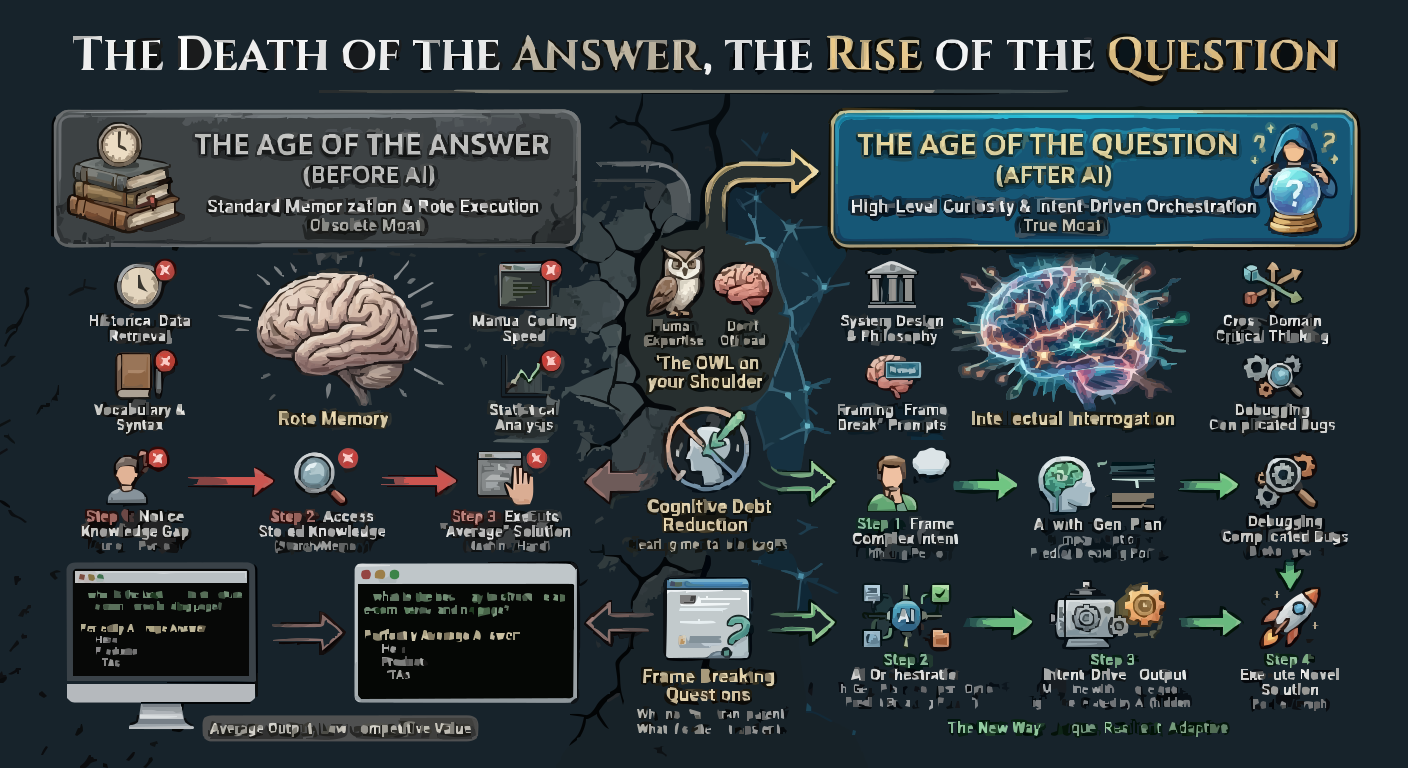
In an AI-shaped world, mechanical execution, rote data retrieval, and standard scripting are being entirely automated away. The global economy no longer rewards what you can memorize or execute repetitively; it rewards Brain Capital—the precise combination of baseline brain health and advanced cognitive skills like continuous adaptation, complex problem-solving, and emotional intelligence.
Younger professionals recognize that while an algorithm can mimic their outputs, it cannot replicate their cognitive synthesis. Protecting and sharpening that biological infrastructure isn’t just a wellness trend—it’s an economic moat.
2. The Danger of “Slopping” and Cognitive Atrophy
This focus on cognitive investment comes at a time of severe vulnerability. A recent landmark report by the McKinsey Health Institute highlights a distinct generational hazard: the outsourcing of human thought.
With the explosion of generative AI tools, entry-level professionals run a massive risk of cognitive underdevelopment. If a young developer, writer, or analyst routinely hands their problem-solving and critical thinking over to an LLM, they become what tech culture calls a “sloopper”—someone who pushes out unguided, automated work without engaging their own mental friction.
The human brain relies heavily on neuroplasticity; it actively strengthens or discards neural pathways based on how intensely it is taxed. Bypassing the uncomfortable struggle of debugging code, structuring a narrative, or parsing raw data acts like a cognitive offloader, slowly dulling creative capability.
Millennials and Gen Z are realizing that to remain leaders in their industries, they must step away from total automation and deliberately put themselves through formative, ambiguous projects that challenge their executive functions. They are using AI as an escalator for their ideas, not a crutch for their intellect.
3. The Structural Pillars of Brain Capital
True “brain wealth” isn’t built on vague wellness promises or expensive, unverified smart drugs. According to neuroscientific frameworks and public health initiatives—such as Europe’s major Brain Health Mission—cognitive capital is built on highly modifiable, everyday lifestyle structures.
Younger generations are systematically optimizing their lives around these core pillars:
Precision Resistance & Activity
Physical exercise is no longer just about aesthetics or cardiovascular health. Regular physical activity alters body composition, acts as a primary defensive mechanism against cognitive decline, and directly stimulates the expression of neurotrophic factors that promote neurogenesis (the birth of new brain cells).
The Deep Sleep Premium
Millennials and Gen Z are treating sleep as a non-negotiable performance tracker. Consistently achieving 7 to 8 hours of high-quality sleep per night is the brain’s natural cleanup phase, flushing out metabolic debris and consolidating short-term experiences into structured, long-term knowledge assets.
Nutritious Clean Fuel
The gut-brain axis has moved from niche science to mainstream optimization. Incorporating clean nutrition rich in antioxidants, healthy fats, and micronutrients directly mitigates systemic inflammation—which neuroscientists now know is a major driver of daily brain fog and mental fatigue.
Radical Mental Variety
To build a high “Curiosity Quotient,” young professionals are engaging in deliberate mental gymnastics. Whether it’s learning a completely new programming language framework, reading complex historical texts, or solving spatial puzzles, keeping the brain in a state of continuous learning preserves cognitive flexibility.
4. The $6.2 Trillion Bottom Line
If you think treating the brain as an asset class sounds abstract, the macroeconomic numbers tell a different story. Research indicates that globally scaling proven, cost-effective brain health and cognitive intervention frameworks could reclaim over 260 million disability-adjusted life years and unlock a staggering $6.2 trillion in cumulative global GDP gains.
Forward-thinking corporate organizations are catching on to this reality. Progressive companies are shifting away from superficial workplace perks and investing directly in employee brain capital—providing comprehensive cognitive coaching, self-care libraries, mental flexibility workshops, and communication training for team leaders. Initial case studies show that organizations prioritizing these cognitive environments see a massive, multi-fold return on investment due to heightened innovation and reduced burnout.
The Ultimate Portfolio
The ultimate horizon of wealth management has transformed. While previous generations measured their security by the tangible assets they could acquire externally, the modern builder measures their wealth from the inside out.
Your mind is your engine, your code base, and your creative studio. Protect your focus budget, lean into the productive friction of hard problem-solving, and view every healthy lifestyle choice not as an obligation, but as a direct deposit into your highest-yielding asset: your own mind.
How are you actively investing in your cognitive capital this week? Are you protecting your attention span from algorithmic fatigue? Let’s map out some strategies in the comments below.