
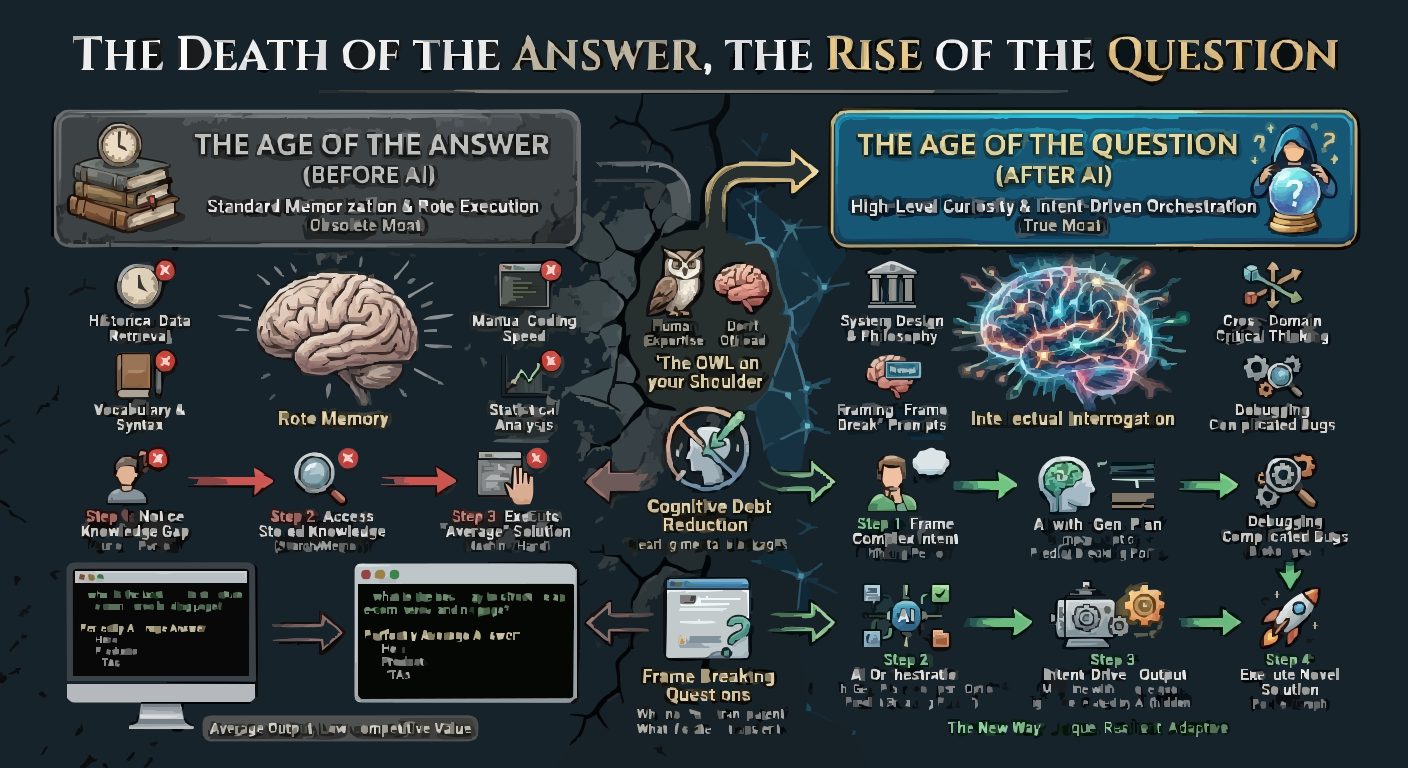
We are living through a strange, quiet paradox.
If you need a 1,000-word essay on the socioeconomic impacts of climate change, you can have it in twelve seconds. If you need a Node.js script to parse an API and handle duplicate database records, it appears before your eyes instantly. If you need a minimalist brand logo or a high-converting landing page layout, a machine will generate thousands of variations while you take a sip of coffee.
UNESCO+ 1
For the entirety of human history, the answer was the prize. The person who held the answers—the one who memorized the textbook, mastered the syntax, or retained the exact historical data—won the game. Education was built on measuring how many answers you could store in your head, and corporations paid premiums for the speed at which you could retrieve them.
UNESCO
But when answers become a free, infinite commodity, their market value drops to zero.
We have reached the Death of the Answer. And in its wake, a new competitive landscape has emerged: The Rise of the Question. When any machine can give you the what, your ultimate competitive advantage becomes your capacity for high-level curiosity — the ability to ask why, what if, and how do we break this entirely?
1. The Commodity of the “Average Answer”
To understand why curiosity is your only true economic defense mechanism, we have to look at how Large Language Models (LLMs) actually function.
AI does not experience human intuition, nor does it possess lived context. At its core, an AI platform performs mathematical pattern matching. When you ask a standard model a question, it searches its vast training data to find the most probable, statistically average solution.
Harvard Gazette+ 1
- Ask an AI: “What is the best way to structure an e-commerce landing page?” It will return: Hero section, product features, testimonials, Call to Action (CTA).
Srinivas Rao - Medium
- Ask an AI: “What is the best Python framework for a lightweight API?” It will immediately suggest Flask or FastAPI.
Srinivas Rao - Medium The problem isn’t that these answers are wrong; the problem is that they are perfectly, beautifully average. They represent the exact middle of the internet’s collective dataset. If you build your software house, your clothing brand, or your content strategy purely on the first answer an AI gives you, you are building a carbon copy of what everyone else is building.
Srinivas Rao - Medium+ 1
When execution is automated, the “average answer” becomes background noise. Distinguishing yourself requires rejecting the baseline frame.
Srinivas Rao - Medium
2. The Danger of “False Fluency” and Cognitive Offloading
There is a psychological trap developing in our relationship with modern technology, which cognitive scientists call cognitive offloading. Because we know a digital tool can remember things for us, our brains naturally stop investing the energy to form deep, long-term neural pathways.
Policy Options - Institute for Research on Public Policy+ 1
Recent studies from institutions like the MIT Media Lab have begun sounding the alarm on a phenomenon known as Cognitive Debt. Researchers found that professionals who blindly rely on AI to generate strategic documents or code scripts without doing the foundational cognitive heavy lifting show a severe decline in creative problem-solving and critical thinking.
Frost & Sullivan Institute
This leads to a state of False Fluency. A developer might use an AI to generate a complex full-stack architecture. The output looks clean, polished, and functional. But because the developer bypassed the mental friction of building it from scratch, they lack an innate understanding of the underlying logic. When a subtle, compounding bug inevitably occurs deep within the production environment, they are entirely unequipped to debug it because they don’t know what to ask the machine to fix.
Frost & Sullivan Institute
The Insight: AI should not do your thinking for you. It is not a replacement for domain expertise; it is an amplifier of it. To use an oracle effectively, you must already understand the architecture of the kingdom.
Harvard Gazette+ 1
3. High-Level Curiosity: The New Tech Stack
If standard technical execution and rote memorization are no longer the primary differentiators, what is? It is Intent-Driven Orchestration—the art of conceptualizing completely novel ideas and deep-diving into unique prompts.
UNESCO
Your new “tech stack” isn’t just the programming languages you know; it’s your Curiosity Quotient (CQ). High-CQ individuals interact with AI through a concept known as the Frame Break.
Srinivas Rao - Medium
Breaking the Frame Harvard Gazette
A low-curiosity individual accepts the AI’s first response and copies it into their project code or essay draft. A high-curiosity individual steps back and questions the structural premise.
Harvard Gazette+ 1
- Instead of asking for a standard landing page, they ask: “Why does a landing page need a hero section at all? What happens to the conversion rate if we treat the interface like a command-line terminal for the user’s problem?”
Srinivas Rao - Medium
- Instead of asking for a standard app architecture, they ask: “What if we skip the database entirely for this feature and orchestrate a transient state utilizing memory caching? What are the breaking points of that approach under a 10x load?” This is not simple prompting; it is intellectual interrogation. It requires you to treat AI as a collaborative sparring partner, pushing the boundary of the system until it yields something entirely unique.
Srinivas Rao - Medium+ 1
4. How to Cultivate Your Competitive Advantage
How do you protect your mind from cognitive atrophy while utilizing the most powerful tools ever created? You deliberately train your curiosity.
Harvard Gazette
1. Shift from Output to Intent
When working on a digital project—whether it’s building a software automation or drafting a brand narrative—spend 70% of your time defining the core problem, the constraints, and the underlying philosophy. Let the AI handle the final 30% of mechanical syntax generation. Your value is in the system design, not the keystrokes.
2. Follow “Unproductive” Rabbit Holes
Innovation happens at the intersection of entirely unrelated fields. Don’t just read about your own industry. If you’re a software engineer, read about architectural geometry, luxury fashion typography, or sports psychology. When you bring frameworks from outside your domain to an AI prompt, you force the model out of its standard statistical averages and into highly creative territory.
Srinivas Rao - Medium
3. Practice Active Meaning-Making Frost & Sullivan Institute
Never copy-paste an answer you don’t fully understand. If an AI generates a script or a strategy, interrogate it: “Why did you choose this design pattern over alternative X? Explain the trade-offs in memory consumption and scalability.” Force the machine to teach you, ensuring that you are building human expertise alongside digital assets.
Frost & Sullivan Institute+ 1
The Ultimate Horizon
The future does not belong to the people who can code the fastest, write the most words, or generate the most images. The future belongs, stubbornly and magnificently, to those who wonder.
Policy Options - Institute for Research on Public Policy
The machine can simulate an infinite number of answers, but it cannot generate the initial, burning human spark of desiring to know. Keep your mind active, embrace the mental friction of problem-solving, and remember: The owl sits on your shoulder—never let it sit in your seat.
Harvard Gazette+ 1
What’s a major “frame break” question you’ve asked recently that completely changed how you approached a project? Let’s talk in the comments below.