
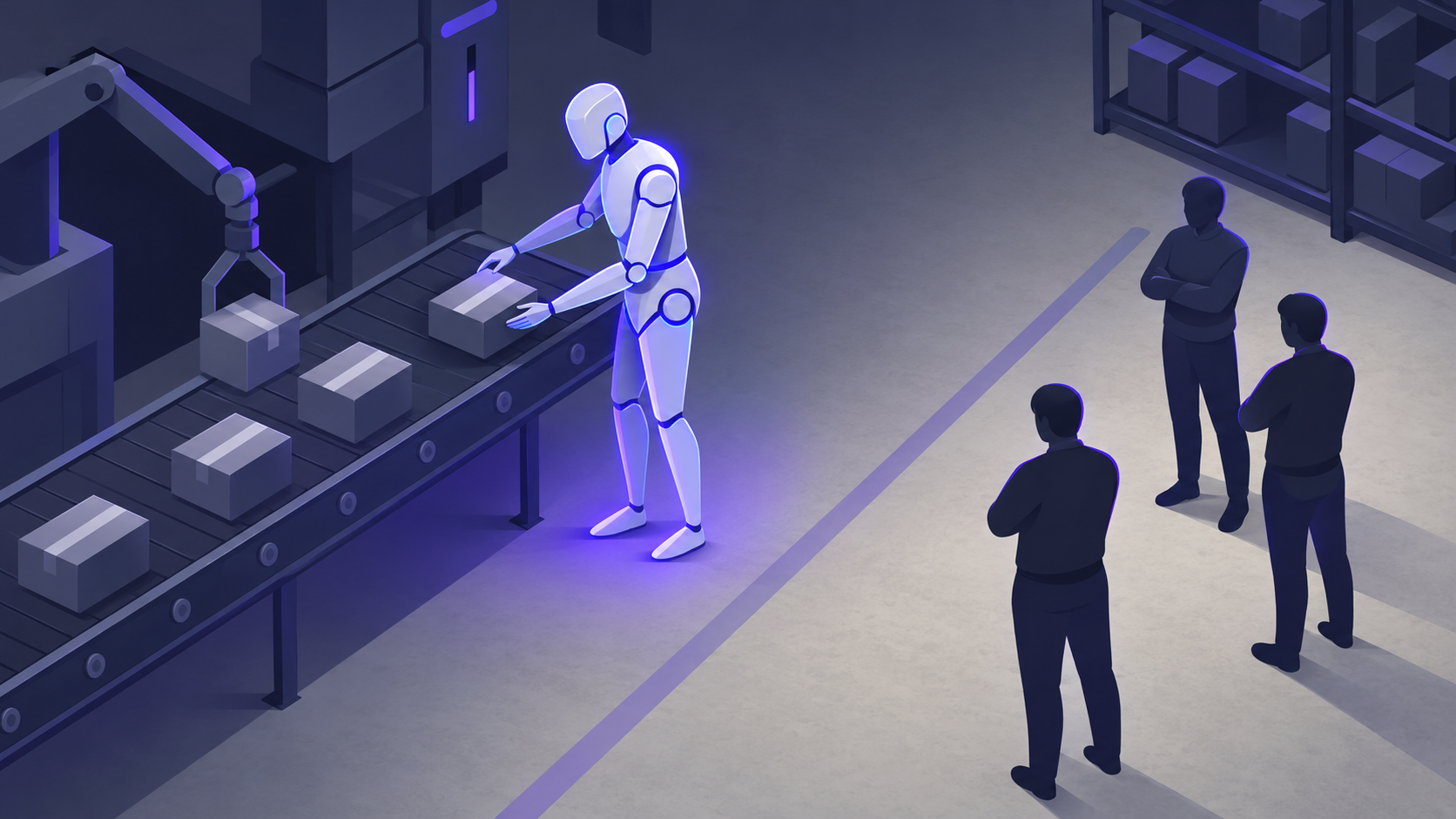
On February 1, 2026, Boston Dynamics’ Atlas became the first enterprise-grade humanoid robot deployed at Hyundai’s Metaplant Application Center in Georgia — autonomously handling materials and order fulfillment, including navigating itself to charging stations and swapping its own battery. That’s a genuine engineering milestone. It’s also, by most accounts, the industry’s first documented labor-displacement flashpoint at scale: worker strike activity broke out at Hyundai facilities in direct response to the humanoid integration, and it’s serious enough that the Atlas program’s public sentiment score has cratered to 2.5 out of 10 across recent coverage, despite the technology working exactly as advertised.
That tension — genuine technical success paired with genuine labor backlash — is the real story of humanoid robotics in 2026, and it’s a more interesting story than the usual “robots are coming” headline suggests.
This Is the Year Demos Became Deployments
For most of the last decade, humanoid robots lived almost entirely in research labs and trade-show demo reels — impressive to watch, rarely doing real work. That changed decisively in 2026. Robots are now walking actual factory floors, sorting real warehouse inventory, and beginning to show up in early home pilots. The technology quietly enabling this shift is Vision-Language-Action (VLA) models — systems that translate natural language instructions directly into physical movement, integrating vision, language understanding, and motor control into a single trainable pipeline. It’s widely described as the most significant architectural shift in robot learning since end-to-end imitation learning emerged in 2022, and 2026 is the year it moved from research artifact to production infrastructure.
The Deployments That Are Actually Real, Not Just Announced
It’s worth separating genuine, verified deployments from marketing announcements, since the industry has plenty of both right now.
BMW’s Figure 02 program is probably the most substantively documented case. Over an eleven-month pilot at BMW’s Spartanburg, South Carolina plant, the robot logged more than 1,250 operating hours, loaded over 90,000 sheet-metal parts, and took roughly 1.2 million steps while supporting production of more than 30,000 BMW X3 vehicles — working ten-hour shifts, Monday through Friday, placing metal parts into welding fixtures to five-millimeter precision with better than 99% placement accuracy. That success prompted BMW to expand the humanoid program to Europe for the first time, and Figure has since retired the original units in favor of Figure 03 for a logistics sequencing role at the same plant.
Amazon has taken a two-pronged approach: deploying Digit, a bipedal humanoid built through its majority stake in Agility Robotics, for tote handling inside active fulfillment centers (including a GXO-operated Spanx facility in Georgia), while separately acquiring a New York robotics startup called Fauna Robotics in March 2026 to build out a consumer home-robot platform. Own the industrial fleet, own the home platform — a strategy playing out simultaneously.
Japan Airlines deployed two Unitree-based humanoid platforms, at roughly $15,400 per unit, for baggage loading, container transport, and aircraft cabin cleaning — repetitive, physically demanding work in an environment (airports) deliberately built around human-scale infrastructure, which is exactly the case humanoid designers make for choosing the human form factor over wheeled alternatives.
The Numbers Behind the Hype
Global humanoid robot shipments are projected by IDC to exceed 510,000 units by 2030 — a compound annual growth rate approaching 95%. To put the current baseline in context: 2025 shipments exceeded 18,000 units globally, but more than 85% of those deployments were concentrated in performances, education, guided tours, and data collection — demonstration and validation work, not genuine production labor. Manufacturing and logistics pilots, like BMW’s and Amazon’s, were only just beginning to emerge. Chinese vendors accounted for roughly 95% of global shipments in 2025, and several are projected to reach annual production capacity in the tens of thousands by the end of 2026 — a manufacturing scale advantage that’s likely to shape which companies actually win this market, independent of whose robot is technically most capable.
Four Companies, Four Different Bets
The competitive field has effectively narrowed to a handful of platforms most likely to show up in a real facility within the next two years: Boston Dynamics’ Atlas, Figure’s Figure 03, Tesla’s Optimus, and Unitree’s H2/G1 lineup. Each is making a distinct strategic bet. Tesla announced Optimus 3 — described by Elon Musk as the most advanced robot in the world — with production targeted for summer 2026, though the company has yet to publish verified third-party deployment figures the way Figure and Boston Dynamics have. Unitree is pursuing a Robot-as-a-Service model aimed at academic labs, training centers, and enterprise innovation units, with strong early sentiment but real geopolitical exposure tied to its Chinese manufacturing base. Figure and Boston Dynamics, by contrast, have the most substantively verified industrial deployment data of any platform on the market right now — actual operating hours and production output, not just demo footage.
The Part the Industry Is Less Eager to Talk About
The Hyundai strike is worth sitting with, because it’s the first concrete evidence that humanoid deployment triggers real labor pushback the moment it moves past isolated pilots into environments where jobs are visibly at stake. It’s a meaningfully different reaction than earlier waves of industrial automation drew, and it’s a reasonable bet this won’t be the last flashpoint as more of these deployments scale up across other unionized manufacturing environments. The technology working exactly as designed and the social response to that technology working are turning out to be two entirely separate storylines, running in parallel rather than one following cleanly from the other.
Where This Actually Goes From Here
The honest read on humanoid robotics in 2026 is that the industry has crossed a real threshold — from “impressive lab demo” to “verified operating hours in a live production environment” — but it’s crossed that threshold unevenly. A handful of companies (Figure, Boston Dynamics, Amazon’s Agility-backed program) have genuine, dated, third-party-verifiable deployment data. A larger number of heavily marketed competitors remain in pre-order status, enterprise-only limited availability, or vague “coming soon” territory, and the gap between those two groups is likely to widen rather than close over the next year, simply because production deployment data compounds — the companies with real operating hours today are the ones best positioned to refine their systems fastest.
What’s less certain is whether the social and labor questions raised by the Hyundai strike get resolved as smoothly as the underlying engineering has. Robots reliably hitting 99% placement accuracy on a welding line is a solved problem in a way that “how do factories and their workforces adapt to that robot’s presence” clearly isn’t yet — and unlike the technical challenge, that one doesn’t have a straightforward engineering fix.