
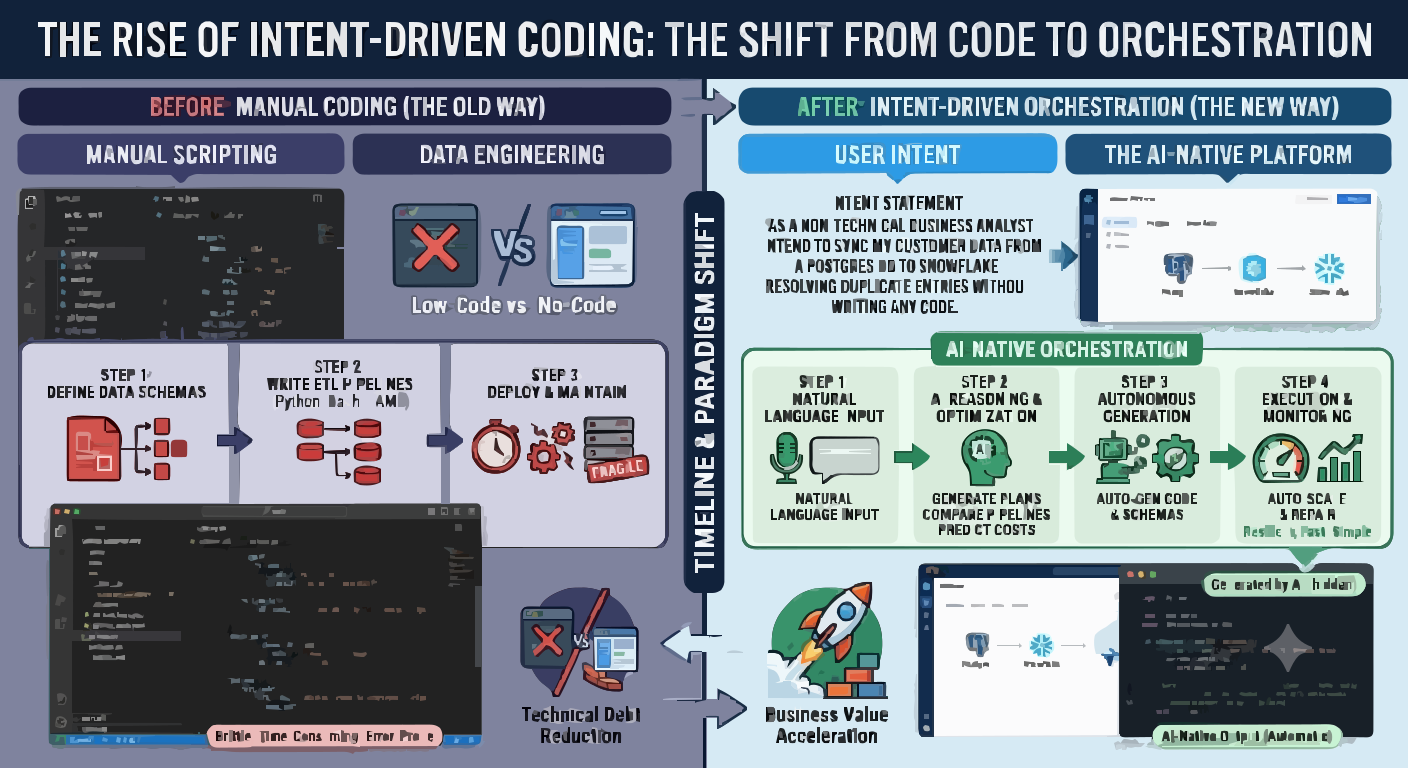
For fifty years, “writing software” meant one thing: a human typing syntax into an editor, line by line, function by function. That definition is now breaking apart in real time. In 2026, the fastest-growing skill in software isn’t a programming language — it’s the ability to clearly express what you want built and let AI systems figure out how to build it. This is the shift industry analysts are now calling intent-driven coding (or intent-driven development): moving from manually writing code to orchestrating AI-native platforms that translate human intent directly into working software.
This isn’t a minor productivity upgrade. It’s a structural change to what a “developer” does all day, and it’s happening faster than most engineering organizations have adjusted to.
What Intent-Driven Coding Actually Means
At its core, intent-driven coding flips the traditional workflow. Instead of a developer translating a requirement into syntax themselves, they describe the outcome they want — a feature, a fix, a data pipeline, an integration — and an AI agent plans the implementation, writes the code, runs the tests, and iterates until the result matches the intent.
One industry write-up put it plainly: software development has changed to the point where engineers no longer type most code by hand — they describe intent, and AI agents plan tasks, edit across files, run tests, and open pull requests, with many now shipping to production with limited supervision. Anthropic
This is a meaningfully different posture than the “AI autocomplete” era of 2023–2024. Back then, tools like early Copilot suggested the next line or function while a human stayed in the driver’s seat for every keystroke. Intent-driven coding treats the AI as an active collaborator — sometimes a fully autonomous one — that owns entire tasks from specification to delivery.
From “Vibe Coding” to Real Agentic Workflows
It’s worth separating intent-driven coding from the looser, more casual practice sometimes called “vibe coding.” Analysts draw a clear line here: agentic coding differs from “vibe coding,” which involves quick, iterative prompting for exploration or demos — agentic coding is a more autonomous, goal-oriented process, analogous to delegating a complete task to a capable junior engineer who works independently but under supervision. MarkTechPost
The distinction matters because it explains why this shift is durable rather than a fad. Vibe coding is great for prototypes and throwaway demos. Intent-driven, agentic development is being built for production systems, with guardrails, review gates, and audit trails — the scaffolding real engineering organizations need.
Modern agentic systems now operate through what practitioners call execution loops rather than single prompt-response exchanges. As one analysis of the 2026 landscape describes it, the biggest change is that agents are no longer limited to short prompt-response interactions — they can run for minutes or hours, and this shift from chat-based assistance to autonomous execution loops is the defining transformation of modern coding agents. AY Automate
The New Skill: Context Engineering, Not Prompt Engineering
If you assumed the key skill in this new era is writing clever prompts, the reality on the ground says otherwise. Developers working with agentic tools have converged on a different discipline entirely. In spec-driven workflows, developers write detailed feature specifications and architecture notes that agents reference during implementation, and those specs become part of the agent’s persistent memory — the real skill in working with coding agents is no longer prompt design, it’s context engineering. AY Automate
In other words, the job has shifted from “how do I phrase this instruction” to “how do I structure the surrounding information — architecture docs, coding conventions, prior decisions, test criteria — so an AI agent can reason correctly about a large, unfamiliar codebase.” Anthropic’s own research frames this as a form of repository intelligence: AI that grasps not just lines of code but the relationships and intent behind them. Blog MentallizeNOW
The Platforms Powering the Shift
A crowded field of AI-native development platforms has emerged to support this new workflow, each with a different philosophy:
- Claude Code (Anthropic) — recognized for elite reasoning and planning capabilities, backed by a context window of over 1 million tokens, with particular strength in complex refactors and navigating large, intricate codebases. MarkTechPost
- OpenAI Codex — known for powerful GPT-5.x models, multi-agent worktrees for parallel tasks, and a context system built around AGENTS.md files, with a cloud sandbox mode that lets developers queue up dozens of tickets and return later to finished pull requests. MarkTechPost
- Cursor — an AI-native fork of VS Code with a hybrid model that combines local IDE responsiveness with cloud-based agents for long-running and parallel tasks. MarkTechPost
- Devin — takes autonomy furthest, operating primarily in the cloud where teams can run multiple instances simultaneously, each working on a different engineering task, functioning less like an assistant and more like a software engineer you assign work to. AY Automate
- Windsurf — built around its Cascade agent system, notable for “codemaps” that create structured representations of large codebases, helping agents reason about dependencies and architecture across large repositories. AY Automate
- GitHub Agent HQ — launched February 2026, letting developers run Claude, Codex, and Copilot simultaneously on the same task, each reasoning differently about trade-offs. Blog MentallizeNOW
The common thread: these platforms are converging on shared architectural patterns — persistent memory, tool use (file system, terminal, version control), multi-agent orchestration, and human checkpoints for high-stakes decisions.
The Numbers Behind the Shift
The scale of adoption is no longer anecdotal. A few data points illustrate how fast this has moved:
- By April 2026, Claude Code alone accounted for roughly 4% of all GitHub commits globally, with some companies reportedly moving away from manual coding entirely. Ssntpl
- On the model-capability side, benchmark performance has improved dramatically: top models paired with a suitable agent harness now achieve success rates exceeding 70–90% on SWE-bench Verified, up from roughly 4% in 2023 — a rough proxy for how reliably AI agents can resolve real-world GitHub issues start to finish. MarkTechPost
- Enterprise appetite for coordinating multiple agents has exploded too: Gartner reported a 1,445% surge in multi-agent system inquiries between Q1 2024 and Q2 2025, and by 2026, 40% of enterprise applications are predicted to include task-specific AI agents. Blog MentallizeNOWBlog MentallizeNOW
- Workflow automation is also climbing steadily: one industry analysis pegs current agentic tooling as handling approximately 60% of developer work, extending beyond autocomplete into code generation, reviews, testing, and autonomous operations. Webfuse
Multi-Agent Teams: The Next Layer of Orchestration
Perhaps the most important structural trend inside intent-driven coding is the move from single AI assistants to coordinated teams of specialized agents. Rather than one general-purpose model handling everything, organizations are now deploying specialized agents that work in parallel on different parts of a problem, mimicking a human software team — a front-end agent, a back-end agent, a QA agent, a security agent, each with a narrower scope and deeper competence in its domain. MarkTechPost
This mirrors how human engineering teams are structured, and it’s changing what the human’s job actually is. As one write-up on AI-native product development puts it, developers haven’t become obsolete — they’ve become “conductors of an orchestra” rather than individual musicians. The core competency shifts to context engineering — structuring logical thinking so that AIs execute the technical vision with precision, alongside systems architecture and the judgment to know when to intervene. DEV CommunityAugment Code
What the Developer’s Job Actually Looks Like Now
Contrary to the fear that AI eliminates the need for developers, most serious analyses describe an evolution rather than a disappearance. The engineering role is shifting toward:
- Agent orchestration — coordinating multiple AI systems toward a complex goal, rather than writing every function by hand.
- Context and specification design — shaping how AI understands a codebase, business logic, and intent through structured docs and persistent instruction files.
- Critical evaluation — reviewing AI-generated output for correctness, security, and maintainability rather than assuming it’s correct by default.
- System design for AI — architecting applications where AI agents are first-class components of the system, not bolted-on tools.
Industry commentary sums up the shift memorably: the 10x engineer could become the 100x engineer — not by writing more code, but by orchestrating agents that do. Elsewhere, the framing is even starker: “in 2026, code is a commodity; prompt architecture and product vision are the true competitive differentiators.” Blog MentallizeNOWAugment Code
Governance Is Catching Up — “Bounded Autonomy”
As agents take on more responsibility — including shipping directly to production — organizations are getting serious about guardrails. The dominant governance pattern emerging in 2026 is what’s being called “bounded autonomy”: giving agents clear operational limits, mandatory escalation paths to humans for high-stakes decisions, and comprehensive audit trails. Practically, this looks like approval gates for any agent action touching production systems, plus formal AI governance frameworks — over 60% of enterprises are expected to require formal AI governance, such as ISO 42001 certification, by 2026. Blog MentallizeNOWBlog MentallizeNOW
This governance layer isn’t bureaucratic overhead so much as a recognition that intent-driven development only works at scale if there’s a trustworthy system of checks between “the AI thinks it’s done” and “this is safe to deploy.”
The Honest Counterpoint: This Isn’t Frictionless
It’s worth resisting the hype cycle here, because the data on real-world outcomes is mixed. A large developer survey found that 67% of respondents agree AI often produces code that looks correct but isn’t reliable, and one widely cited study found experienced developers were actually 19% slower when using AI tools, despite reporting that they felt faster. Enterprise research on large-scale rollouts found similar friction: teams that skipped foundational groundwork before adopting AI coding platforms saw code review time increase 40%, bug rates rise 9%, and pull request complexity balloon 154%, even as perceived productivity went up. Webfuse + 2
The takeaway isn’t that intent-driven coding doesn’t work — it’s that treating it as a magic productivity switch, without investing in specs, review processes, and measurement, tends to produce worse outcomes than expected. The organizations getting real gains are the ones treating context engineering, evaluation, and governance as first-class engineering disciplines, not afterthoughts.
Why This Shift Is Happening Now
Three forces are converging to make intent-driven coding viable in a way it simply wasn’t two years ago:
- Model reasoning has crossed a usability threshold. Benchmark jumps from ~4% to 70–90% success rates on real-world coding tasks in under three years represent a genuine capability inflection point, not incremental tuning.
- Context windows and retrieval have scaled to real codebases. Million-token context windows and semantic dependency analysis across hundreds of thousands of files mean agents can now reason about entire systems, not isolated files.
- Tooling has matured beyond chat. Agents now have real access to terminals, file systems, version control, and CI/CD pipelines — the actual instruments of software delivery — rather than just generating text a human has to manually apply.
Together, these make it possible for a human to express intent at a much higher level of abstraction than “write this function,” and reasonably expect a working, tested implementation to come back.
The Road Ahead
If 2023–2024 was the era of AI-assisted autocomplete and 2025 was the year agentic coding tools proved themselves on real repositories, 2026 looks like the year intent-driven development became the default expectation for new software teams — not a novelty, but the baseline way serious products get built. The organizations adapting fastest aren’t necessarily those with the most AI tooling; they’re the ones rebuilding their engineering culture around clear specifications, careful evaluation, and orchestration skills instead of raw typing speed.
The code itself is increasingly becoming infrastructure — generated, tested, and maintained by systems working on behalf of human intent. What remains distinctly human, and more valuable than ever, is knowing exactly what to build, why it matters, and how to judge whether the result is actually right.