
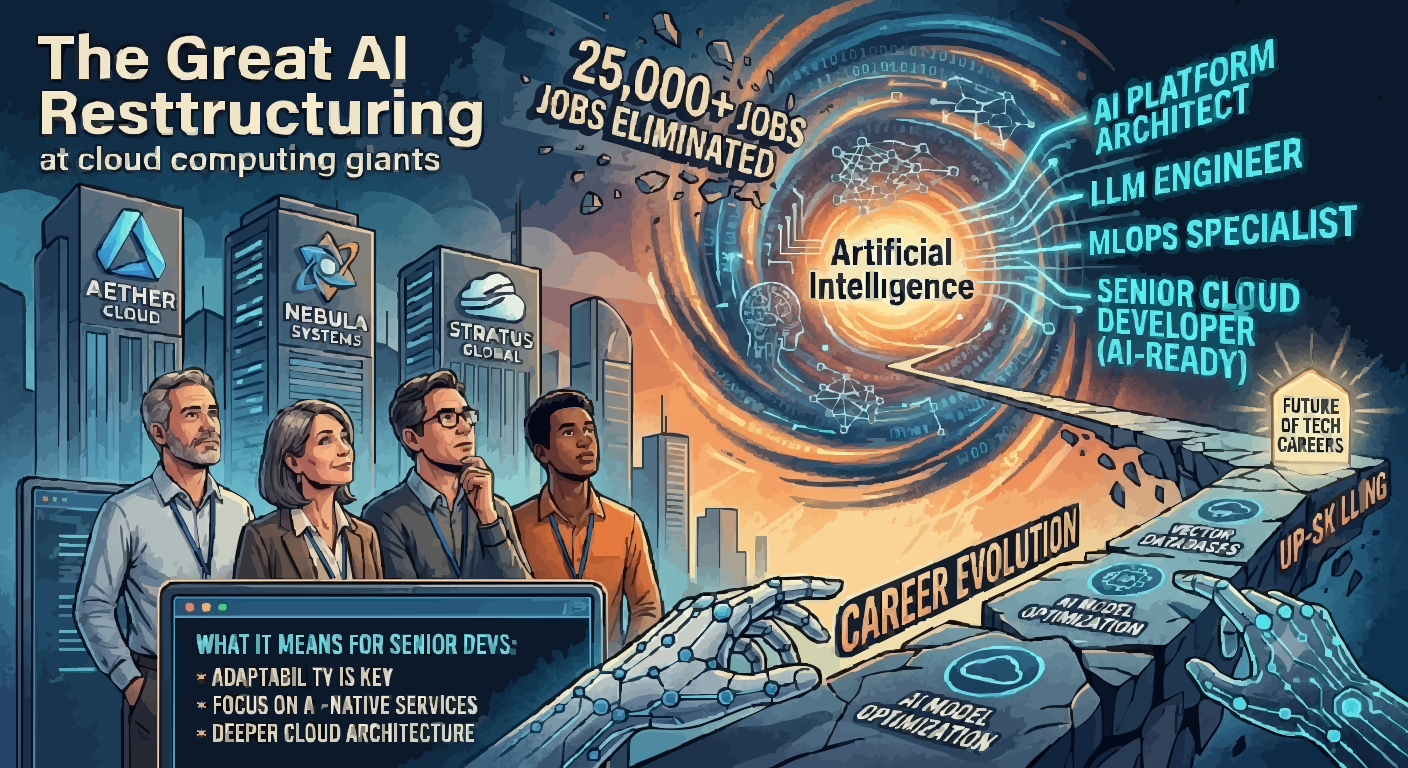
The headlines dominating the tech sector point to a confusing reality. Major cloud infrastructure platforms and software houses are reporting massive demand, soaring corporate revenues, and multi-billion dollar enterprise contracts. Yet, the corporate chopping block has never looked more active.
We have officially entered The Great AI Restructuring.
In the first half of the year alone, the tech industry cut over 120,000 roles. The absolute epicenter of this disruption lies within the cloud giants themselves. From Oracle executing a historic reduction of roughly 21,000 to 30,000 positions to Microsoft’s sudden elimination of 4,800 jobs, the narrative coming out of corporate PR rooms remains identical: We are streamlining teams to fuel the artificial intelligence boom.
But if you look past the standard corporate press releases, a darker, far more strategic game is being played. The modern tech restructuring wave isn’t an admission of financial failure; it is an aggressive, calculated re-allocation of human resource capital.
For senior software engineers, this represents the most significant shift in the employment paradigm since the 2001 dot-com bust. Here is the unfiltered truth about why these layoffs are happening, the financial reality behind them, and how senior developers must adapt to survive.
1. The Real Driving Force: The AI Capital Expenditure Tax
The public is frequently led to believe a simplistic myth: AI tools became so efficient at writing code that corporations simply replaced thousands of human engineers with automated bots.
This is a flat-out lie. AI is changing how work gets done, but the technology hasn’t advanced to autonomous system orchestration. The true driver behind the 25,000+ jobs eliminated by cloud giants isn’t AI efficiency—it is AI Capital Expenditure (CapEx).
[Traditional Revenue] ---> [Corporate Balance Sheet] ---> [Massive Layoffs (Legacy/Health/SaaS)]
                                                                  |
                                                      ($8B - $15B Reclaimed Cash Flow)
                                                                  |
                                                                  v
                                                    [Hyper-Scale AI Compute Data Centers]
Building the physical infrastructure required to win the global AI race is staggeringly expensive. Cloud providers are throwing down historically unprecedented sums of money to build hyper-scale data centers, secure specialized semiconductor chips, and fund compute deals.
- Oracle’s Capital Expenditures rocketed toward an estimated $50 billion for the fiscal year—billions more than originally projected—largely to fund massive computing infrastructure commitments like their multi-billion dollar partnership with OpenAI.
- Microsoft’s Azure Network is seeing booming AI demand, but the astronomical operational cost of scaling physical data centers to run those services has created a massive squeeze on cash flows.
To free up the billions of dollars required to purchase physical AI hardware, companies are treating their existing human workforces as a financial liquidity tap. They are cutting deeply into legacy departments, SaaS product units, and mid-tier consulting wings to instantly free up the cash flow necessary to build the physical data fortresses of the future.
2. The Corporate Illusion of “AI Washing” Layoffs
There is a secondary, deeply cynical reason why tech corporations love blaming AI for structural restructuring. Industry analysts and economists call it “AI Washing.”
During the low-interest-rate environment of the pandemic, major tech firms over-hired dramatically, building bloated mid-level management layers and supporting experimental, non-core divisions that yielded minimal profit margins. In a normal economic climate, cutting these departments en masse would signal internal trouble, spooking Wall Street and depressing stock valuations.
By framing the job cuts under the banner of “AI transition and structural modernization,” executives transform an organizational correction into a forward-looking technological evolution. Wall Street rewards the phrase “AI optimization” with surging stock prices, allowing underperforming companies to hide standard right-sizing maneuvers behind futuristic branding.
3. The “Gartner Bombshell” and the Productivity Trap
This aggressive strategy of cutting seasoned engineering headcounts to balance the AI ledger is already creating massive internal friction. A landmark research study by Gartner exposed an uncomfortable truth: cutting human headcount to finance AI investments does not inherently yield superior business returns.
Many tech houses that rushed to replace foundational human labor with algorithmic pipelines are hitting a hard execution wall. The resulting phenomenon is a widespread productivity trap:
- The Burnout Cycle: When an enterprise cuts 15% of its workforce while keeping software requirements identical, the remaining senior engineers are forced to absorb a staggering amount of extra cognitive load.
- The Code Quality Collapse: Overworked engineers increasingly rely on automated code generation tools to hit aggressive sprint deadlines. Because these tools generate statistically average code, deep-seated architectural bugs, memory leaks, and hidden security vulnerabilities accumulate silently inside production environments.
- The Repatriation of Labor: As these mistakes compound, companies are discovering that AI cannot autonomously monitor or fix complex enterprise systems. Consequently, an increasing number of mid-tier companies are quietly re-hiring the exact same experienced engineers they previously laid off, occasionally at adjusted salary levels, simply to clean up the technical debt left by unchecked automation.
4. The New Playbook for Senior Software Engineers
In an environment where technical execution can be quickly drafted by an assistant, what is the survival blueprint for a senior software engineer? The job market has fundamentally elevated its requirements. To remain completely indispensable, you must adapt your positioning immediately.
Shift from Code Velocity to System Design & Philosophy
If your primary value proposition is how fast you can type standard scripts or write boilerplate code, you are competing directly with a commodity tool. Senior developers must reposition themselves as System Orchestrators. Your value lies in understanding system requirements, projecting edge-case breaking points under 10x loads, and maintaining clear data governance—skills that require human intuition and domain expertise.
Lean Heavily into Platform and Cloud Infrastructure Engineering
While standard application-layer development is facing intense pressure, the physical demand for infrastructure management is skyrocketing. Senior engineers who master platform engineering, high-efficiency hybrid architectures, secure networking overlays, and local hardware optimization are commanding massive premiums. The industry desperately needs builders who know how to connect systems efficiently, not just write isolated functions.
Adopt “Frame-Breaking” Curiosity
When interacting with automated coding agents, do not act as a passive user who accepts the first average code output. Treat the model as a junior developer. Interrogate its architectural choices, demand detailed performance trade-offs, and push the platform to its limits. The ultimate competitive moat is your Curiosity Quotient (CQ)—knowing the exact complex questions to ask to unlock exceptional technical value.
Conclusion: The Ultimate Moat is Your Expertise
The Great AI Restructuring is a painful but necessary wake-up call for the technology ecosystem. The era of comfortable, unchecked tech expansion has evolved into a disciplined focus on capital allocation and high-efficiency systems architecture.
The cloud giants can eliminate thousands of traditional coding roles to pay for their physical data servers, but they cannot buy the human ingenuity required to orchestrate them. Keep your skills aligned with high-level system design, refuse to offload your critical thinking to an assistant, and treat your deep domain expertise as your ultimate professional moat.
Frequently Asked Questions (SEO Featured Snippet Optimization)
Q: Are AI tools the primary reason for tech layoffs?
A: No. While AI is changing day-to-day development tasks, the primary cause of modern tech layoffs is financial capital reallocation. Cloud giants are cutting legacy headcounts to free up the massive amounts of cash flow needed to build expensive physical data centers and buy premium AI hardware.
Q: Which engineering roles are most at risk during tech restructuring?
A: Roles centered around repetitive tasks—such as manual QA testing, basic technical documentation writing, and entry-level junior developers who cannot work effectively with automated assistants—face the highest risk of contraction.
Q: How can a senior software engineer remain competitive right now?
A: Senior engineers must pivot away from boasting about pure coding speed and focus on high-level system design, cost-efficient infrastructure optimization, and cross-domain critical thinking. Specializing in platform engineering and understanding how to orchestrate AI models safely inside private architectures are massive career differentiators.